

Capstone team designs fixture to catch battery assembly errors
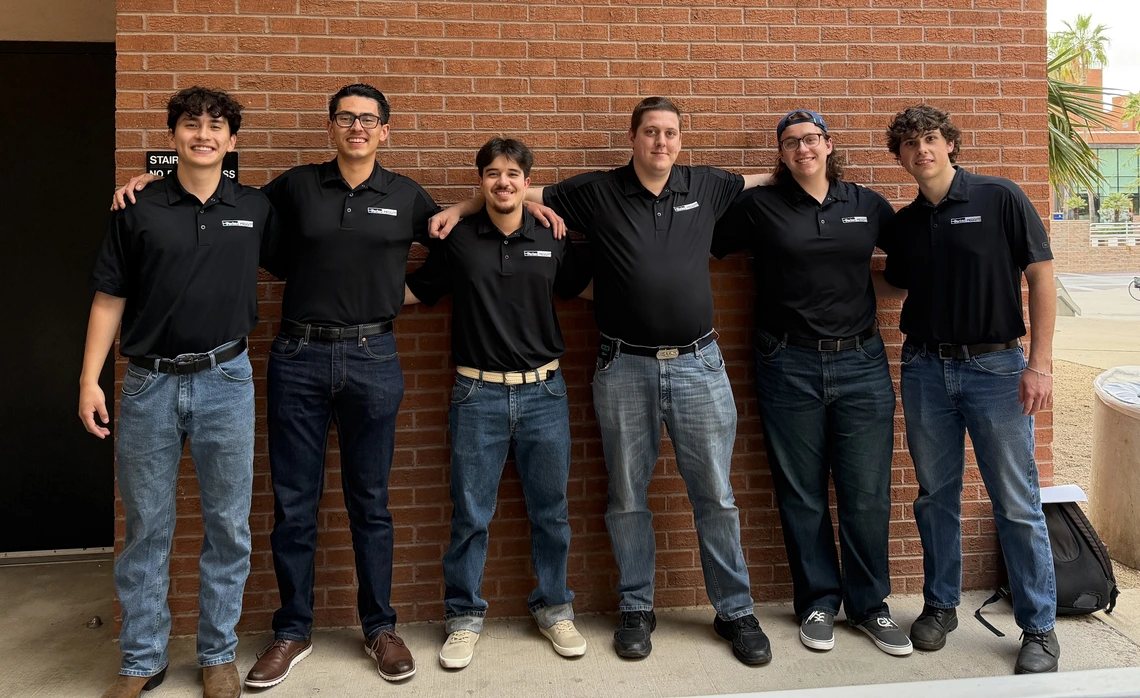
(From left) Marcel Lopez, Michael Aufmuth, Sebastian Mercado, Gregory Knuffman, Allen Leinberger and Connor Milton of Capstone Team 26505 design a fixture that improves the safety and traceability of lithium-ion batteries for aircraft.
A single misplaced lithium-ion cell can put technicians at risk during aircraft battery manufacturing. Systems engineering senior Michael Aufmuth and his Interdisciplinary Capstone teammates set out to catch that mistake before it reached the production line.
Team 26505 partnered with sponsor Securaplane Technologies Inc., a Parker Meggitt business, to design an error-scanning fixture for the company’s next-generation LMBx modular lithium-ion batteries. Each battery holds 48 cylindrical cells and powers critical systems on aircraft from major manufacturers like Boeing and Airbus.
Cells installed in the wrong position can cause an electrical short and endanger technicians.
“Right now, when mistakes are made, cells can be laser-welded in the wrong orientation, which is costly because those cells will have to be thrown out,” Aufmuth said.
Securaplane engineers identified the problem while developing and certifying the battery system. Patrick Hogan, a Securaplane mechanical engineer and the team's sponsor, said bringing the project to the capstone program let the company add capabilities a basic in-house design might have lacked.
“These included scanning and logging each individual cell, verifying cell voltage to screen for nonconforming cells and automatically saving production data for traceability,” he said. “Those features strengthen both process control and quality assurance.”
Preparing for Design Day
The team has already built a prototype with two layers of verification: An artificial intelligence-equipped camera that checks each cell’s orientation and an electrical test that confirms its voltage and polarity. The system also scans and logs each cell’s barcode or serial number, creating a record for quality control.
“The ability to actively monitor assembly steps, record production data and automatically alert operators to errors has broad value across our site,” Hogan said.
With a prototype in the pipeline, the team plans to present a working product at the Winter Craig M. Berge Design Day on Dec. 4.
“I’m most excited to see us put together a product that’s 90% of the way there,” Aufmuth said.
If the fixture succeeds, Securaplane could build it into its assembly line to improve process control, operator safety and traceability.
“It’s cool knowing that what we’re building could actually become part of their manufacturing process,” Aufmuth said.
For Hogan, the project also reflects the value of giving students a chance to work on projects they may encounter in the workforce.
“We continue to partner with the College of Engineering because the program consistently delivers strong results,” he said.
“It is also a meaningful way for us to give back to the university and provide students with exposure to real aerospace design, manufacturing, quality and safety challenges.”